


Acapulco Beaches - Complete Guide to Beaches in Acapulco
Complete Guide to Glorious Beaches of Acapulco
Acapulco has some of the best beaches in Mexico, perhaps some of the best beaches in the world. From Pie de la Cuesta to Caleta to the Golden Zone and out to Puerto Marqués and Diamante, there are dozens of great beaches to choose from, each with a distinct personality.
With the exception of the outlying beaches west and east of town (like lower Revolcadero), Acapulco doesn't offer great surfing. But it is always the right place for sunning, lounging, beach games, jet ski riding, eating, drinking, swimming, sailing and fishing. Acapulco´s close-in beaches are usually very busy, especially during high season. The more remote locations do not attract large crowds or beach vendors.
Pie de la Cuesta
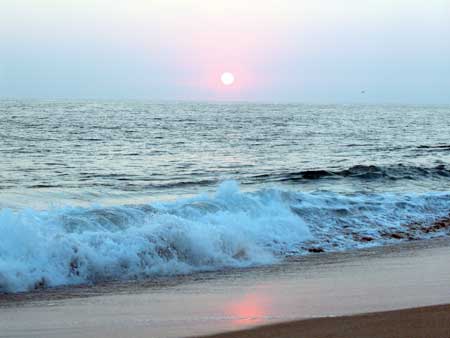
Pie de la Cuesta is miles and miles of yellow sand beach. You can literally start walking early in the morning and not reach the end until the afternoon. The beach is great, but the ocean here can be very strong. Pie de la Cuesta beach runs parallel to the Coyoca Lagoon. A variety of restaurants and places to stay welcome you at the entrance to the beach. They spread out much more as you move along up to the end where the lagoon meets the sea. The beach is an excellent choice for those who love peace and quiet or who enjoy relaxing in a totally natural tropical setting. The sunsets here are so breathtaking that Pie de la Cuesta could be nichnamed "sunset beach." (Some people think that this is the Spanish translation of its name; however, "Pie de la Cuesta” means “Foot of the Slope,” where the high ridge around Acapulco comes down to the sea.)
Roqueta and Marin Beaches
Playa Roqueta and Playa Marin are a pair of quiet, rustic beaches located on the Isla de la Roqueta off the coast of the traditional section of Acapulco (Acapulco Nautical). These beaches are fantastic for quiet relaxation, and they are a must for the ecotourist. The only access is by boat. Water taxis are available at Playa Caleta on the mainland. Playa Roqueta is the island's principal beach. Playa Marin is a small, remote, undeveloped beach, which can only be reached by taking a small hike from Playa Roqueta.
Playa Angosta
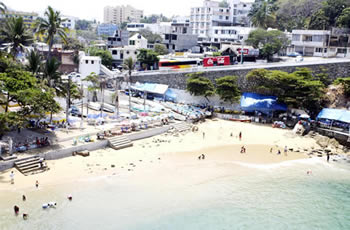
Playa Angosta means “narrow beach” in Spanish, and it is rightly named. It is a favorite hideout for those seeking to avoid the more crowded beach locales. Playa Angosta is a narrow stretch of sand, sandwiched between two big cliffs. It is the next inlet over from La Quebrada, where the cliff divers perform. Playa Angosta is really the only beach in Acapulco proper where you can catch a full sunset into the Pacific Ocean, right up to the point when the sun turns into a colorful dot on the horizon and then disappears. Not much is available in the way of services – just a couple of places for food and drink. Finding Playa Angosta can be difficult. Walk from La Quebrada to the Sinfonia del Mar and keep on going to the sea below.
Playas Caleta & Caletilla

Playas Caleta and Caletilla are two of Acapulco's traditional beaches and favorites of locals and tourists alike. The two are really one contiguous beach separated by an aquarium building called “Magico Mundo Marino”. These beaches are a great place to relax and listen to a musician's guitar, drink a cerveza, get a message, and swim in the calm waters. This was the original "place to be" back in the days when Acapulco was just a quiet fishing community, suddenly discovered by Hollywood's rich and famous. Caltea and Caletilla form a fairly small beach front, which fills up every morning with locals, Mexican tourists, and a smattering of Europeans, Canadians, and Americans. This is no longer the beach of the celebrities and of the rich. It has loads of local color. The nearby hotels (in Acapulco’s “Traditional Zone”) were once the best in town, but more recently they serve tourists on a budget. Some of them still provide an excellent vacation experience. This beach represents a pleasant exposure, not only to the sun and sea, but to the local culture as well.
Playas Manzanillo & Honda
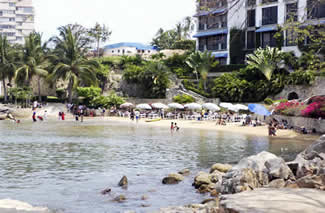
These two neighboring beaches are in the stretch of the bay between Caleta and the downtown area. They are out of the way and potentially tricky to find. Just look for the lighthouse nearby and the marina. A few rustic, but delicious seafood restaurants are in the area. The beaches themselves can sometimes be noisy and crowded, depending on the time of day. A great sightseeing opportunity is the boat graveyard to one side of the beaches, near a gathering place for local fisherman. There’s even an old VW Beetle there, too.
Playa Tlacopanocha
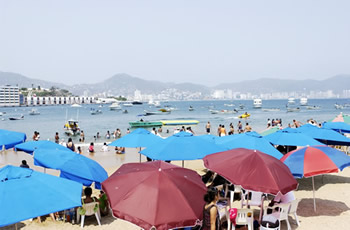
This busy beach is located right at the end of the Malecón (town pier) and across from the Maritime terminal. It's a great place to watch the cruise ships pull in or take off, and it presents a great chance to take in some authentic Mexican culture.
Playa Las Hamacas
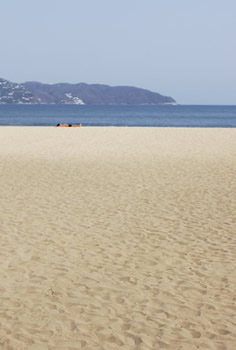
Playa Las Hamacas is noted for its wide, flat expanse of sand. Located across from the Hotel Las Hamacas, it is a neighbor of Tamarindos and Hornos Beaches. This beach attracts less traffic than the others, as it is not an ideal spot for lounging around on the sand or spreading out your towel. Playa Las Hamacas is a great vantage point for taking photos of fishermen and the boats. Photographers can almost always find great subject matter here.
Hornitos Beach
Hornitos Beach is sometimes called “Papagayo Beach” because it is right in front of Parque Papagayo. The restaurants and vendors cater to Mexican families and tourists. As a result, it is a place where the kids love to run around, and it has more than the usual amount of litter. It is also a hangout for taxis and the tourist police, by the base of the main flag pole.
Hornos & Tamarindos Beaches
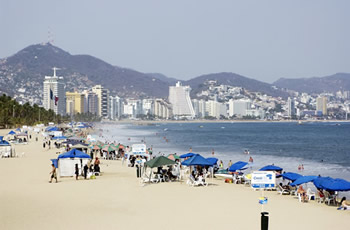
Playa Hornos and its neighbor, Playa Tamarindos, are closer to Acapulco’s Traditional Zone than Playa Hornitos, and they offer a bit more to the tourist. There are rows of large coconut palms and several good beach restaurants. The sand is cool and clean. The water is somewhat calmer than in the beaches farther to the east in the Golden Zone. Playa Hornos and Playa Tamarindos appeal to many locals and visitors from Mexico City. Many international tourists come here as a quieter alternative to the more hectic Condesa and Icacos beaches. Playa Tamarindos extends for about 700 meters down the beach from the Hotel Las Hamacas to approximately where the Hotel Acabay is located.
Playa Morro
Playa Morro, close to the Diana traffic circle, is a small buffer area between the two more distinct and opposite personalities of Hornitos and Condesa. It can easily be recognized by the hilly island offshore, called a “morro” in Spanish. Businesses local to Playa Morro like to call it “Condesa,” perhaps because that name resonates more with the tourists. The waves around the small rocky island in the bay, just offshore, can create excitement for those who like their beaches with a little extra ocean current.
Playa Condesa
Playa Condesa can be considered “Golden Zone Central” -- the place where hedonism and tourism intersect. La Redonda (a big craggy rock) rests just off shore. You can find parasailing and jet ski rentals all over. This beach always attracts large numbers of people, many of them partiers, and it offers great views of the hotel zone. The section of Playa Condesa below “Beto’s Condesa” restaurant and bar on the Costera Alemán is said to be Acapulco's premier gay beach, extending from the area known as “Las Piedras” eastward to the end of the beach. The water can sometimes be too choppy for real swimming, but it is fine for wading. Boogie boarding and surfing are really not feasible here.
Icacos Beach

Playa Icacos is the other big beach in Acapulco’s Golden Zone. In places it is almost twice as wide (waterfront to back wall) as Condesa Beach, offering as much as 200 feet of space. The sand and the water are clean, and the restaurants and beach bars are very welcoming. Jet ski rentals are available all up and down the beach. This beach serves mainly the hotels and condominiums in Costa Azul. As a result, the beach crowd is a bit more upscale than on the beaches closer to the downtown center. The view out into the open sea is sensational, and the sunsets are often dramatic.
Playa Guitarrón
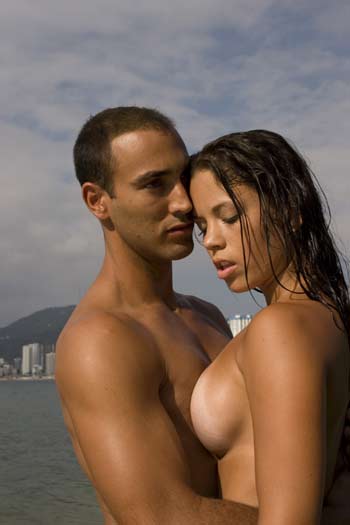
A small beach in the gated community of Brisas Guitarrón, generally inaccessible to the public. The Radisson Acapulco Resort dominates this location.
Playa Pichilingue
This beach is really inaccessible to most people as it serves the guests of the guests of the Camino Real Hotel and the resort community of Pichilingue Diamante. The beach is quiet, both because it has relatively few visitors, and because it is on the shore of a beach inside the tranquil inlet of Puerto Marqués.
Playa Puerto Marqués & Majahua
Many locals will tell you that Playa Puerto Marqués and Playa Majahua are their favorite beach hangouts in Acapulco. These two spots are both small by comparison to the bayside beaches. Their waters are calm, as the beaches front on the lush green cove that is Puerto Marqués. This is an inviting place to come for a swim, as the water is calm and clean. It also has a great atmosphere, as many locals choose Playa Puerto Marqués and Playa Majahua as their favorite place for fun. Generally these beaches have few tourists compared with the bay side and Playa Revolcadero. The beach area is surrounded by the village of Puerto Marqués, where there are several shops and a number of rustic seafood restaurants that really deserve a try. The tide comes into the bay quickly at the end of the day, and by late afternoon, few people remain. These are not beaches to visit during evening hours.
Playa Revolcadero

Playa Revolcadero (literally, “tumbler beach”) is a long, wide stretch of sandy strand on the open ocean by the Hotel Fairmont Acapulco Princess, one of Acapulco's most luxurious hotels (the one that resembles a big Mayan pyramid). On weekends in the late morning, the beach fills up with Acapulco's chic crowd, who are trying to get a tan and recover from a hangover at the same time. Here the beautiful, elegant and well-to-do come to play, run, lie in the sun or relax under the canopies and in the cabanas. This is also a favorite beach for swimming. Playa Revolcadero always has waves of a fairly good size, but seldom are they dangerously strong. If the red flags are out, however, be sure to heed them. Revolcadero Beach usually has far less undertow than the beaches in the Golden Zone.
Playa Tres Vidas
Playa Tres Vidas is on the Pacific Coast to the east and south of Revolcadero Beach and the airport, but before Barra Vieja. It is home to a well-known and exclusive golf resort, with a tiny, top-level boutique hotel on the grounds, called L'Hotel de Tres Vidas. The beach is accessible from outside the resort area, though parking will be "unofficial." Few people can be found on this beach, other than the occasional surfer or guest of the resort above. The golf course features many holes along the coastline, some of which will be visible from the water. If you are unfamiliar with Acapulco's beaches, it would be wise to visit Playa Larga or Revolcadero first. Then you might make your excursion towards Tres Vidas to see it for yourself.
Playa Larga
Playa Larga, or in English “long beach,” is a very long stretch of beach on the way to Barra Vieja and a great place for ecotourists and those who like the tropics to be like the tropics - primitive and undeveloped. It's about half a dozen miles from Puerto Marqués and begins shortly after Playa Revolcadero. Here one can find campsites, a sea turtle hatchery, and a few places to stay. The beaches are usually very quiet, with few others around, and no beach vendors. Unlike Acapulco's other beaches, Playa Large does not have a view backwards to the mountains behind. Access is best accomplished by car. (The taxi ride is long and expensive, and it will be hard to find one for the trip back.) Allow 30-45 minutes of travel time from the center of Acapulco. Parking is available. In theory it is free; however, as elsewhere in Mexico, the “car watchers” who freelance there require a small fee for their services, and nobody would ever be so imprudent as to decline them.
Playa Bonfil
Playa Bonfil is a popular beach with surfers. It lies right behind Acapulco’s international airport and is best reached by car. Parking is available. The wave quality is described as “regional classic.”. Waves can be strong. The bottom is sandy, and waves come both right and left. The surf is fast. Swell size starts at 1 meter and holds up to 2.5 meters. Often described as a remote beach in paradise, Playa Bonfil also is host to a number of luxury condos, set in a tropical landscape, with just a few services available (food and beverage) down on the beach.


