Legend of Acapulco
The mystery of Acapulco is heightened by a local legend, first told many centuries ago in the dwellings of the indigenous Yope, and retold many times over, down to the present day. The shield of Acapulco is said to represent this story, but the link between the drawings and the narrative is a bit abstract. Perhaps that just adds to the mystery.
Many, many years ago, long before the spade-bearded Spaniards arrived at these shores, a small tribe of Yope Indians lived peacefully on the coast, fishing the azure waters, harvesting coconuts, tamarinds and mangos, and living the pleasant and peaceful life of a tropical beach culture. The beach life style was not destined to last forever. A tribe of warlike Nahuas came along to disrupt it. They chased the peaceful Yopes away from the beaches and into the hills, where life was much harder. The Nahuas then settled down to the easy life on the beaches where the Yope had been.
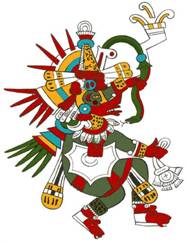
Not too long after the arrival of the Nahuas, a son was born to the chief. He was given the name Acatl, which means reeds. The Chief proudly entrusted him to Quetzalcóatl as his protector. The Nahuas were more restless than their predecessors, so after a while, they set off again in search of something new and different. By this time, young Acatl had turned into a handsome warrior and, as was customary among the Nahuas, headed off in search of a bride. While on the road he met and fell in love with a beautiful girl who was the daughter of a Yope chief.
By coincidence, this beautiful princess, Quiahuitl by name, was the daughter of the chief of the very tribe his father had defeated years before.
When her old man discovered the identity of his future son-in-law, he was filled with hatred and resentment. He not only refused his permission for the marriage, but he cursed the young warrior, asking the gods to punish him. Poor Acatl, miserable, returned to the place of his birth to grieve. He brooded and sobbed so much that eventually his tears became a river, which soaked his fine physique to such an extent that he melted and turned into a muddy pool. Eventually reeds grew up around this pool and were referred to as his children.
Now Quetzalcoatl eventually heard how cruelly his protégé had been treated and as punishment to the Yope Chief turned his beloved and perfectly innocent daughter, Quiahuitl, into a cloud. She floated aimlessly for a long while until eventually she came across a muddy pond with reeds growing round it.
Bitter and twisted as she was by now, she flew into a hideous rage as she recognized her lost lover's children swaying in the breeze. They should, of course, have been her children. She transformed into a torrential downpour that wrenched poor Acatl's children from the ground and left them to die in a crumpled mess. It did, however,
do a good job of entwining the lovers forever in a place that came to be known as "Acapulco" -- Nahuatl for the “place where reeds were destroyed.”
This tragic tale of jealousy, intrigue, selfishness and infanticide is indeed a plot worthy of any afternoon TV drama.
Pre colonial History of Acapulco
Pre-colonial history may be no more verifiable than the “Legend of Acapulco” because the Spanish invaders – to their eternal shame and condemnation – destroyed all the records they could lay their hands on. Experts estimate that the area around Acapulco had been inhabited for 5,000 or so years before the Spaniards arrived early in the 16th century. That there was prehistoric life here is hardly surprising, in light of the agreeable climate, the lush vegetation, abundant fauna and the generosity of the sea. The material evidence consists of the usual array of bones and other artifacts, shells and seeds, all arranged so as to make human presence a certainty. The earliest communities probably had only a few inhabitants and were sparsely distributed because each needed a large territory for hunting, fishing and gathering. The high ridges around Acapulco protected these small communities from much contact with the outside world.

The earliest inhabitants carved petraglyphs in nearby rocks, like Palma Sola (see photo). This relatively small pre-Columbian site may be eclipsed by more important digs elsewhere, but it is truly worth a visit. It showed that life was at least calm enough to give the locals enough freedom to do a little something other than just working to stay alive.
Around the time of King Solomon in Judah (three thousand years ago), a drastic change took place in Acapulco. A new people, which now are called the Nahua, entered deep blue bay and gave it its name.
Their society was more structured than that which it replaced, and from artifacts it seems as if they were related to the Olmecs, who dominated on the Gulf of Mexico side of the country.
Then, probably around 1200 AD came the Méxica (pronounced “MEH-she-ka”). They were distant relatives of the local residents. Each group had come from one of the seven original tribal divisions of the Nahuas, said by legend to have left the “place of the seven caves” (“Chicomoztoc”) to live in “Aztlán,” a kind of paradise. The Méxica had migrated away from Aztlán, and were instructed by their god, Huitzilopochtli, to adopt the name Mexica. In spite of this, Spanish soldiers, and then later the scholars, used the name “Aztec” (inhabitants of Aztlán) to describe the Méxica. This misnomer has been the source of great confusion. Some descendants of these indigenous peoples are still sensitive about it and reject the use of "Aztec" when applied to the rulers of central Mexico.
Unlike the Olmecs and coastal Nahuas, the Méxica were a warrior society that survived by means of conquest, enslavement and tribute. They established a large and flourishing empire in the central parts of modern Mexico, from sea to sea, with a large and well-functioning bureaucracy and system of centralized government. The dominion of the Méxica reached its height in the mid- to late 1400's. They divided what is modern day Guerrero State into seven territories, introducing a system for collecting tribute and imposing decisions of a central government on local leaders. It is said that Acapulco never came under the direct control of these people, but rather were governed by local political bosses. Without a doubt, Acapulco’s culture was strongly affected by the Tarasca, Mixteca, Zapoteca and Méxica civilizations.
The Arrival of the Spanish
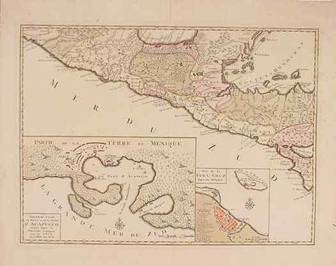
Ten years after the last expulsion of the moors and the Jews from Spain, and ten years after the discovery of the New World, Hernán Cortés landed in Mexico with a large contingent of Spanish soldiers. Once ashore, he burned all the vessels in his fleet, signaling that for this group of conquistadores, there was no way to go back home. It was 1502. By 1521 the Spanish would have conquered all the indigenous peoples.
The advancing Spaniards stumbled across Acapulco Bay (more correctly, La Bahía de Santa Lucia). It as a perfect natural harbor for Spanish ships on the west side of the continent. Not only is Acapulco sheltered from all but worst hurricanes, but also it has a deep channel. Moreover, it was also the largest natural port on the Pacific coast. For 300 years, Acapulco reigned as the “pearl” of the Pacific. By 1534 the Spanish had discovered silver in nearby Taxco, attracting more and more settlers to the area. Acapulco’s natural harbor made the Asian trade possible, even though it took 12 days or more to cover the rough road between Mexico City
and Acapulco. Acapulco was thus the point of departure east to China and the Philippines, and the western terminus of the road to Veracruz, from which ships would depart back to Mother Spain. From Acapulco ships went as far as Alaska in the north and to Peru and Chile in the South. The biggest problem remained the rough road to
Mexico City, making Acapulco isolated but also semi-autonomous for many, many decades.
By the mid 1650's the galleons would depart to the orient for a full year’s round trip journey for trade goods – silks and spices and other luxuries. Much of this treasure would find its way to Spain, but Acapulco enjoyed its share of luxury goods, too, especially as the locals became more wealthy and genteel.
Annually the Governor General would accompany the Viceroy of New Spain in the difficult descent from Mexico City to Acapulco, just to welcome the incoming vessels from the Orient. The ships’ cargo included silk and ceramics, jewels, ivory, cloves, pepper, tea, and cinnamon.
Piracy
Throughout the fifteenth and sixteenth centuries, England and Spain vied for hegemony on the high seas. Each rushed to create colonies in the New World in a race for wealth and political power. Mariners from each country found it a lucrative practice to prey upon the trading vessels of their rival, stealing the treasure and disrupting the trade. Some of these volunteers were commissioned by the crown; others – many others – were just working for themselves. These were the “pirates,” (or privateers), who have been so romanticized in story and song.
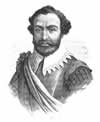
The two most bothersome English pirates were Francis Drake (later knighted) and Thomas Cavendish.
Drake was a pirate with a commission from the English crown, and a portion of his prizes went to enrich the monarch. Cavendish was a “privateer,” in that he was pestering the Spanish with the blessing of the English, but he was basically working for his own account.
The English pirates, in smaller, more nimble craft, could easily arrest the bulkier galleons, killing the crew (or capturing them into slavery) and stealing all the cargo. They equally enjoyed invading port towns like Acapulco and sacking them of everything valuable. Cabo San Lucas, at the tip of Baja California was a favorite
place for the pirates to hide, out of sight of the galleons, until they came close by land. Acapulco’s bay is also hidden from view of the high seas, but sometimes it was protected by a detachment of Spanish infantry, unlike the more desolate Cabo. In 1615, Viceroy Diego Fernandez de Córdoba built a fort in Acapulco, mainly
for protection against the ambushes and escapades of the pirates. This magnificent bastion, Fort San Diego, still stands in the Traditional Zone. The local residents and all the stores of trade from the Orient would fit inside the fort, safe from the raiders. The powder magazine was built in a separate and smaller fortified structure, away from the main fort, as a precaution against fire. The star-shaped Fuerte de San Diego is a great attraction, having been recently restored. It has many exhibits about different aspects of Acapulco’s history.
Part of Acapulco’s colonial history involves slave trade. Slave trading was a routine practice of the Spanish, and so Acapulco became a center of slave trade, along with all the other mercantile activity. The slaves were imported to work in the mines for silver and gold, and continued to be bought and sold well into the 19th century. Many, however, escaped, and took up residence in the mountainous parts of the coast south of Acapulco, called the “Costa Chica,” where descendants of African slaves still live.
Even though the trade with the Orient tapered off and eventually ended, Acapulco still continued to grow and prosper under Spanish rule, but always somewhat to the side, as it was so inaccessible to the big authorities who stayed in Mexico City and on the Gulf Coast.
Acapulco and Mexican Independence
Mexican Independence. (Note: the “Revolution” refers to the period from 1910 to about 1921, when a populist uprising overthrew Porfirio Diaz, a Mexican dictator, and established a government that at first aspired to be a democratic regime. That is different from “Independence,” which refers to the national uprising a century earlier, in which insurgents demanded independence from Spain. As many Mexicans at the time remained loyal to the crown, this conflict had some aspects of a civil war, and continued off an on for over 11 years. In the US, the “American Revolution” and "War of American Independence”
are interchangeable terms. To the Mexican ear, “revolution” and “independence”
describe two entirely different events.)
Spain lost most of her colonies in the Western Hemisphere in a brief period between 1800 and 1820, more or less. Mexico -- then known still as the jewel of "New Spain" – increasingly yearned for independence from the Spanish Crown. Spain's political influence, wealth and military strength had all waned during the 18th century. The old structure fell apart definitively when Napoleon Bonaparte invaded Spain in 1808. The colonies saw this as a perfect opportunity to declare their separation from the Crown, and most of them did. Some were able to establish their independence with relatively little fighting and bloodshed, but Spain did not give up on Mexico so easily. At the time, Mexico included its present territory, plus Texas, Oklahoma, Arizona, New Mexico, Nevada, California, and parts of Colorado and Oregon. So of course, Spain put up a fight.
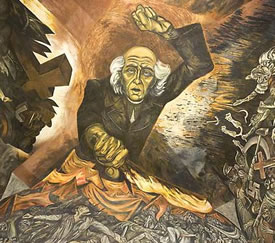
On September 10, 1810, a priest named Manuel Hidalgo started an insurrection against the social injustice that had dispossessed all but Spain-born colonials from holding land or operating an enterprise of any kind. It was a peasant revolution.
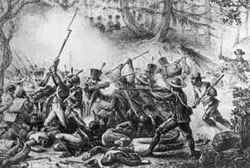
The military engagements of 1810-1811 resulted in the capture and execution of Hidalgo by the forces loyal to Spain. General José Maria Morelos took command of the insurgent army, and in 1813, attacked Acapulco’s Fort San Diego. After a siege of five months, the fort fell to Morelos. Acapulco was important
to the insurgency, as it was the only port of any consequence on Mexico’s Pacific coast. Then, in 1815, Acapulco fell back into loyalist hands for a while. Eventually, in 1821, the Spanish crown conceded independence in the Treaty of Córdoba. The Plan of Iguala, which was the document on which the treaty was based, mandated independence, a single national religion and social equality for all people.
The now independent Mexico had neither money, know-how nor ships to take up the trade with the Orient again. Acapulco slipped back into its quiet role as a big fishing village on Mexico’s southern coast.
When the Mexican Constitution was drafted in 1824, the state of Guerrero did not yet exist. It was divided up amongst the neighboring states. Finally, on October 27, 1849, the new state was created as part of a liberal reform movement spearheaded by generals Juan Álvarez and Nicolás Bravo, and opposed by Antonio
Lopez de Santa Anna (the same Santa Anna that was ultimately defeated when Texas became independent). Over the years Santa Anna was to become president of Mexico on eleven different, non-consecutive occasions, each one punctuated by corruption and controversy. Chilpancingo was made the state capital. It had been declared
the national capital by Morelos in 1813, and boasted a population of 3,000.
The Mexican Revolution of 1910
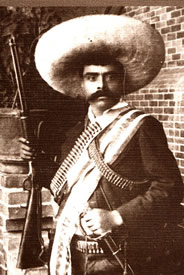
Though isolated geographically, Acapulco was in the middle of the turmoil of Mexico’s revolution. Emiliano Zapata, who was the main revolutionary figure in the south of Mexico, advocated a system of property rights in which those who worked the land should own it. This was distinctly not the philosophy of the few wealthy
caciques (local political bosses), who controlled every move of their peasant underlings. Like feudal overlords, they specified when and what the peasants could plant, and even whether and to whom they should be married. They controlled all the infrastructure of the city of Acapulco and even the roads in and out. Independence, won in the 19th century, had turned to a form of servitude in the 20th.
In 1910, the world’s first socialist revolution took place. Acapulco was still its quiet, fishing-village self, relatively unaffected by the events of the previous 100 years since the trade with Asia had ended. The only international role of Acapulco was its contribution of hundreds and hundreds of young men to the banana plantations of Central America. Ships from the American companies would come by and gather them up and carry them off. Most never returned.
The great skirmishes and mass meetings of the revolutionary era took place elsewhere. Acapulco remained on the sidelines. By the early 1920’s, when most of the fighting had stopped, Acapulco remained remarkably unaffected, except for the vocabulary of socialist ideals, which was very much in vogue at the time. Even the ideological fervor subsided, just as it did in the country’s single, “revolutionary” party, which became a military dictatorship bent on conserving traditional ideals (and the wealthy, governing class).
A key figure in post Revolutionary Acapulco was Juan Escudero. As mayor of Acapulco, he worked hard for a real highway between Acapulco and Mexico City, which, once it was opened, finally made Acapulco accessible to the rest of Mexico and thus to the rest of the world.
Acapulco After the Revolution
It took more than ten years for the revolution to consolidate its political gains in an institutional way. Finally, by the mid-1930’s, the Institutional Revolutionary Party (PRI) arose as a unity party for the nation. The many old feuds amongst Acapulco’s political bosses and power brokers seemed to go away.
The 1920’s and 1930’s was also a period when the city seemed to come back to life. Luxury hotels sprang up and tourists began to arrive. The first fancy hotel was The Papagayo, which, sadly, is no more. It stood where “Parque Papagayo” is now. Other landmarks followed, like El Mirador, El Malecon,
La Marina and El Club de Pesca. Old-timers still speak of with a nostalgic gleam in the eye. The “Hollywood Set,” including such stars as Lana Turner, Johnny Weismuller and John Wayne, soon made Acapulco their getaway for vacation fun.
Then, when Miguel Alemán came into office in 1946, he really pushed for accelerating the economic development of Acapulco.
The 1960’s and 1970’s were periods of student unrest and social upheaval throughout Mexico. The endemic poverty and gross inequalities of treatment between rich and poor, especially as affected the indigenous peoples, brought about the formation of a few guerrilla groups in the Guerrero countryside. The most famous
is the Ejército Popular Revolucionario or EPR, which is still active today in some indigenous pueblos, and which tries to advance a communist ideology. Acapulco has been largely unaffected by such movements, at least so far.
The 1960's was also a time of great expansion. It was then that Acapulco’s “Golden Zone” was opened up, once more thanks in large part to the efforts of now ex-President Miguel Alemán, who, as National Director of Tourism, worked to expand Acapulco’s tourist infrastructure, to make it a modern resort city. Acapulco acquired fame in other countries as a touristic playground, and not just for the rich and famous, but for ordinary people as well.
Today, the tourists still come, but the port is huge now, with well over a million inhabitants, not counting visitors. Many visitors are “second home owners” and prefer to hide behind the high walls of their palatial villas in perfect anonymity. The divide between rich and poor, the new and the traditional -- that dichotomy first illustrated by the struggle of the indigenous peoples against the conquistadores, by the insurgents against the Spanish army, and by the revolutionaries against the vested interests of dictatorship -- that dichotomy continues in Acapulco’s present reality, in which high-rise condominiums soar in front of miserable neighborhoods where most people have no glass in their windows and no potable water.
A Chononlogy of Acapulco History
-
During the 1500's, the conquistadors discovered Acapulco.
-
1532 - Cortés arrives and decides to make Acapulco a base for further exploration.
-
1565 - Commerce between Acapulco and Manila (Philippines) was established and becomes a major trade route between Asia and the Americas.
-
1599 - King Phillip II names the place Puerto de Acapulco (The Port of Acapulco).
-
1617 - Fort San Diego was completed in order to protect the city from pirates.
-
1776 - Fort San Diego was totally renovated after an earthquake destroyed it.
-
1818 - Mexico won the struggle for independence and Mexican forces sacked the fort causing the Spaniards to abandon it. The Asia-Mexico trade route came to a halt.
-
1873 - The Port of Acapulco changes its name to Acapulco de Juárez.
-
1927 - The first highway between Acapulco and Mexico City is opened. Travel time is cut by more than one-half to just a week.
-
1933 - Acapulco's first hotel, El Mirador, is built near the Zocalo.
-
1945 - A new highway was built between Mexico City and Acapulco that shortened the trip to six hours. Acapulco starts becoming a major tourist destination.
-
1950s - Acapulco and Las Vegas become two of North America's hottest spots. Hollywood stars and the jet-set celebrities from around the world come for vacations. Johnny Wiesmuler and John Wayne start a hotel here. Lana Turner stays at the Villa Vera Hotel for three years.
-
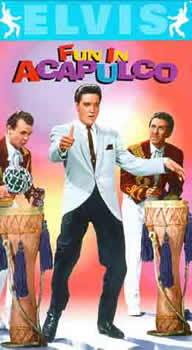
1962 - Elvis makes the film Fun in Acapulco and performs a heroic cliff dive. Acapulco enters the mainstream.
-
1964 - Direct flights to Acapulco are established and Acapulco and domestic tourists begin to crowd out the Hollywood hipsters.
-
1972 - Centro de Convenciones was constructed at a cost of 50 million dollars. It was considered at the time to be the best convention center in the Republic.
-
1976 - Howard Hughes, who had taken up residence in the Acapulco Princess Hotel, suffers kidney failure and is rushed by private plane back to the states. He died in-flight.
-
1980s - Acapulco begins to suffer under competition from purpose-built tourist towns elsewhere in Mexico like Cancun, Los Cabos, and Ixtapa.
-
1997 - Hurricane Pauline tears the city up.
-
2004 - Real Acapulco comes online.
-
2008 - The Sirena Rousta stirs controvery.